
Sub-National Intelligence
Tied to the Tap: How Nigerian States Depend on Federal Transfers
Across six states with reconcilable budget data, internally generated revenue funds anywhere from 51% of revenue (Anambra) down to barely 2% (Borno). Same federal lifeline, radically different self-reliance — and the divide tracks economic geography.
Nigerian states carry heavy spending duties but the strongest tax handles sit at the federal level, so most depend on FAAC transfers (statutory allocation + VAT). Using KANA's reconciliation of state budget documents, this report quantifies each state's reliance on federal transfers versus its own internally generated revenue.
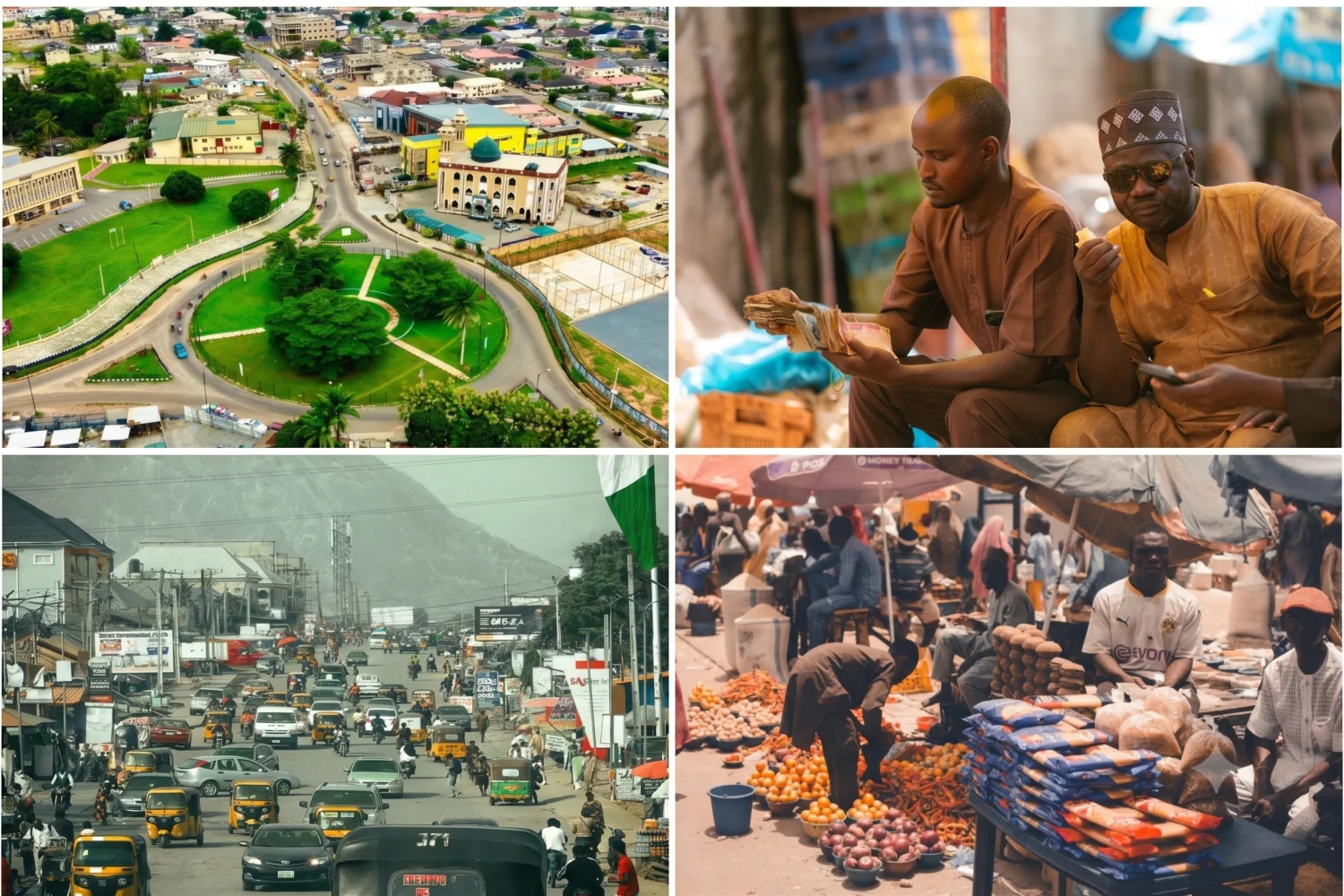
Tied to the Tap: How Nigerian States Depend on Federal Transfers
Across the states where granular budget data exists, internally generated revenue ranges from 51% of revenue down to barely 2% — same federal lifeline, radically different self-reliance.
Executive Summary
Nigeria’s state finances rest on a large vertical fiscal imbalance: states carry heavy spending responsibilities, but the strongest tax handles and the largest shared revenues remain concentrated at the federal level [1][3]. In practice, statutory allocation and VAT receipts — distributed from the Federation Account (FAAC) — are the financial backbone of most states, while internally generated revenue (IGR) is decisive in only a small group of commercially deep, administratively stronger states [1][2].
KANA’s analysis of state budget documents quantifies that divide directly. Across the six states for which granular line-item budgets could be reconciled, IGR finances anywhere from 51% of combined own-plus-transfer revenue down to about 2% [1]. Anambra, in the commercial South-East, raises roughly as much itself as it receives from Abuja. Borno, in the conflict-affected North-East, raises barely two naira of its own for every hundred it spends [1]. The contrast is not random — it tracks economic structure, urbanization, and the strength of each state’s revenue institutions [2][3].
Key findings:
- IGR self-reliance ranges from 50.8% (Anambra) to 2.1% (Borno) across the six states analysed — a spread of nearly 49 percentage points, with an average of about 23% [1]. The typical state in the sample funds roughly 77% of its revenue from federal transfers rather than its own tax effort.
- The dependency gap is starkest in the North-East. Bauchi (90.5% transfer-dependent) and Borno (97.9%) are almost entirely funded from Abuja, while Anambra (49.2%) is the closest to fiscal balance [1].
- Federal transfers are the larger revenue source in all but one of the six states, ranging from ₦36.3bn (Ebonyi) to ₦116.1bn (Borno) — and in the most dependent states they dwarf own revenue by an order of magnitude. Anambra is the lone exception, where own revenue (₦65.3bn) slightly exceeds federal transfers (₦63.3bn) [1].
- Own-revenue capacity diverges enormously, from ₦65.3bn (Anambra) to ₦2.5bn (Borno) — a 26-fold gap that mirrors the difference between a diversified commercial economy and a thin, conflict-disrupted one [1].
- Lagos sits in a class of its own. Though outside this budget sample, Lagos is the documented national outlier, generating the highest IGR of any state and roughly 30% of all states’ IGR combined — financing the majority of its budget internally [2].
1. The Fiscal Logic: Why Nigerian States Differ So Much
Fiscal-federalism theory predicts exactly the pattern Nigeria exhibits [3]. In federations, subnational governments typically face more spending obligations than revenue-raising authority — a vertical fiscal imbalance — so transfers are normal. What varies is how far a state can offset that dependence with its own revenue effort [3].
In Nigeria that offset is highly uneven because the underlying tax base is highly uneven [2]. States with large urban markets, concentrated formal employment, significant property values, and stronger administrative systems collect far more PAYE, levies, and fees. States without those features stay tied to statutory allocation and VAT sharing [2]. Three forces explain most of the divergence:
- Economic structure. Diversified, service-heavy, commercially dense economies produce stronger IGR; narrow or agrarian economies do not [2].
- Administrative capacity. Autonomous revenue agencies, digital collection systems, and tighter cash management raise effective tax yield [3].
- The oil-transfer incentive. Because oil-linked federation revenue arrives automatically through FAAC, the political urgency to build local tax systems has historically been weak — a soft-budget-constraint effect [4].
2. The Evidence: Six States, One Clear Divide
The table below reports each state’s federal transfers (statutory allocation plus VAT), its internally generated revenue, and IGR’s resulting share of the two combined, for the latest budget year that could be reconciled (2017–2019). These are KANA-curated figures drawn directly from each state’s budget documents [1].
Table 1. State fiscal dependence in Nigeria (KANA analysis of state budget documents, ₦ billion)
| State | Year | Federal transfers (Stat. alloc + VAT) | Internally generated revenue | IGR share | Transfer-dependency |
|---|---|---|---|---|---|
| Anambra | 2017 | 63.3 | 65.3 | 50.8% | 49.2% |
| Jigawa | 2018 | 68.6 | 26.8 | 28.1% | 71.9% |
| Abia | 2017 | 52.2 | 17.7 | 25.3% | 74.7% |
| Bauchi | 2019 | 95.5 | 10.0 | 9.5% | 90.5% |
| Borno | 2019 | 116.1 | 2.5 | 2.1% | 97.9% |
| Ebonyi | 2017 | 36.3 | n/a* | — | — |
*Ebonyi’s budget documents in the sample report federal transfers but no usable own-revenue lines, so its IGR share is not computed rather than recorded as zero.
The ranking is unambiguous. Anambra (50.8%) is the only state in the sample approaching fiscal balance — its ₦65.3bn of own revenue actually exceeds its ₦63.3bn of federal transfers. At the other end, Borno (2.1%) and Bauchi (9.5%) are almost wholly transfer-funded: Borno draws ₦116.1bn from Abuja against just ₦2.5bn it raises itself [1].
Figure 2 makes the dependency visible: in Anambra the two bars are nearly level, while in Bauchi and Borno the transfer bar towers over a sliver of own revenue. The pattern maps cleanly onto economic geography — the commercial South-East raises real money; the agrarian and conflict-affected North-East raises almost none [2][4].
3. The National Picture: Lagos and the Long Tail
This six-state sample is a window, not a census — granular budget data could not be reconciled for all 36 states. But it is consistent with the national evidence. Nigeria has one extreme high-autonomy outlier, a small cluster of stronger states, and a large dependent majority [1][2].
Lagos is the outlier. It generates the highest IGR of any state — on the order of 30% of all states’ internally generated revenue combined — and finances the majority of its budget from its own tax base rather than federal transfers [2]. Lagos dominates because of scale, density, formal employment, and deep services, finance, logistics, and property markets — the structural advantages most other states lack [2][3]. Below Lagos and a handful of commercially active states, the long tail of the federation looks like Borno and Bauchi: structurally dependent on volatile, oil-linked federal revenue [4].
That dependence is a risk, not just a description. When oil revenue falls, FAAC allocations fall with it, and the most dependent states have the least cushion. The 2025 tax-reform legislation — which revises VAT sharing toward place-of-consumption and seeks to modernize tax administration — could lift state revenues over time, but the gains will likely accrue first to states that already have consumption depth and collection capacity, widening the gap before it narrows [5].
Policy Implications
For Government
- Treat extreme FAAC dependence as a measurable fiscal-risk metric. States above ~80% transfer-dependency — Bauchi and Borno here — should be required to publish medium-term IGR-expansion plans, because an oil-price shock hits them hardest with the least buffer [1][4].
- Fix revenue architecture, not just tax law, in the bottom tier. States raising under 10% of their own revenue need taxpayer registers, digital payment rails, unified billing, and property enumeration before rate changes can bite [3].
- Reward tax effort in transfer formulas. Allocation can preserve equity for genuinely poor or conflict-affected states while still rewarding those that expand their own tax base [5].
For Investors
- Use IGR share as a proxy for fiscal resilience. A state like Anambra, financing ~half its budget internally, can absorb federal-revenue volatility far better than one like Borno at ~2% — a material difference for sub-national credit and project-execution risk [1].
- Judge state credit by revenue composition, not headline budget size. A large transfer-funded budget is less resilient than a smaller one backed by stable own-source revenue [1].
For Development Partners
- Target mid-tier states for the fastest returns. States in the 25–30% IGR-share band (Abia, Jigawa) have the institutions to convert revenue-administration support into measurable gains quickly [1][3].
- Pair revenue reform with economic formalization. Own-revenue capacity rises when firms register, payrolls formalize, and transactions become traceable — the binding constraint in the weakest states [2].
Data Sources and Methodology
The quantitative core is KANA AI’s own analysis of Nigerian state government budget documents, reconciled into three indicators per state: federal transfers (statutory allocation plus VAT), internally generated revenue (own-source: tax revenue plus fees), and IGR’s share of the two combined [1]. Figures are taken from each state’s approved budget for the latest year that could be cleanly reconciled (2017–2019). National context is drawn from the National Bureau of Statistics’ IGR-at-state-level series and published Nigerian fiscal research [2][3].
IGR share is computed as: IGR ÷ (IGR + federal transfers). Transfer-dependency is its complement, 100% − IGR share.
Limitations
- Coverage. Granular, reconcilable budget data was available for six states, not all 36. The sample establishes the shape and scale of Nigeria’s dependence problem and a defensible ranking among the states covered — it is not a complete national league table [1].
- Year alignment. Because budget-document availability varies, states are compared at their latest reconcilable year (2017–2019) rather than a single common year. State IGR shares are structurally stable year-to-year, so the cross-sectional comparison holds, but the figures should not be read as a single harmonized-year panel.
- Definition. “IGR” here captures the own-source lines present in each state’s budget (principally tax revenue and fees); where a state’s documents omit own-revenue detail (Ebonyi), IGR share is left uncomputed rather than assumed to be zero.
- Lagos is cited from national NBS evidence, not from this budget sample, and is presented qualitatively as the documented national outlier [2].
Appendix — States ranked by internally generated revenue (₦, latest reconcilable year)
| Rank | State | Internally generated revenue (₦) | IGR share of revenue |
|---|---|---|---|
| 1 | Anambra | 65,300,000,000 | 50.8% |
| 2 | Jigawa | 26,800,000,000 | 28.1% |
| 3 | Abia | 17,700,000,000 | 25.3% |
| 4 | Bauchi | 10,000,000,000 | 9.5% |
| 5 | Borno | 2,500,000,000 | 2.1% |
Source: KANA AI analysis of Nigerian state government budget documents (2017–2019) [1].
References
- KANA AI — analysis of Nigerian state government budget documents (statutory allocation, VAT, and internally generated revenue by state, 2017–2019); comparable open state-budget data via BudgIT State of States (statesofstates.budgit.org)
- National Bureau of Statistics — Internally Generated Revenue at State Level (2019–2021) (nigerianstat.gov.ng)
- "Intergovernmental Transfers and Own Revenues of Subnational Governments in Nigeria" — Hacienda Pública Española / Review of Public Economics (link)
- Natural Resource Governance Institute — "Ending Nigeria's Oil Dependency: Not If, When — and How" (resourcegovernance.org)
- "Nigeria Tax Reform Acts: Implications, Challenges and Prospects" — International Journal of Research and Innovation in Social Science (link)
Reference 1 is KANA AI's own activated state-budget data — the quantitative core of this report. References 2–5 are the supporting statistical and research sources consulted for national context.
Disclaimer. This report is produced by KANA AI for informational and educational purposes only. It does not constitute investment advice, a research recommendation, or an offer or solicitation to buy or sell any security, and it should not be the sole basis for any investment decision. Figures are computed from publicly available data and reported company fundamentals, which may be incomplete, delayed, or contain errors; valuation ratios reflect the latest available data and can lag fast-moving prices. Past performance is not indicative of future results. Readers should conduct their own due diligence and consult a licensed financial adviser. KANA AI accepts no liability for decisions taken on the basis of this report.
Next Step
Want to discuss this research or commission a similar analysis?
KANA AI can produce tailored research reports for your specific market, sector, or investment thesis.